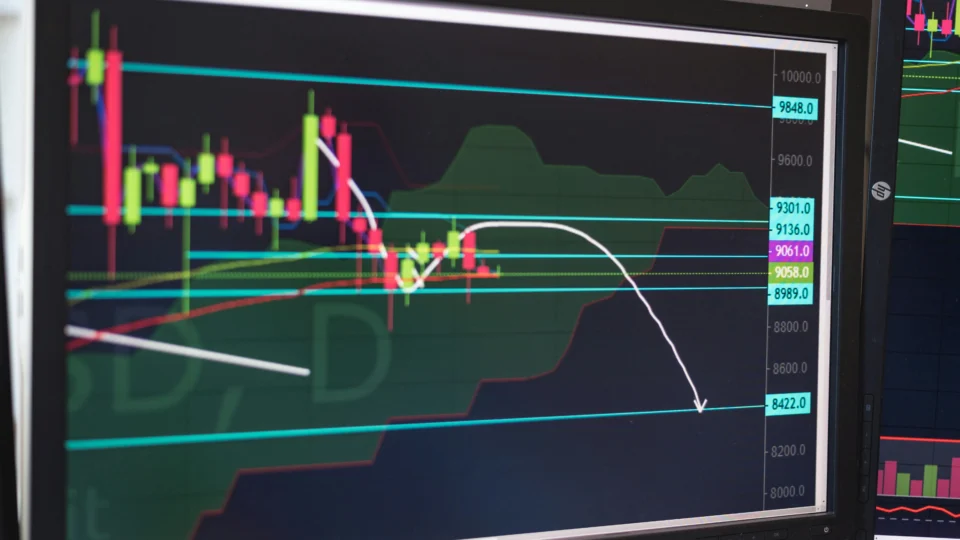

Bitcoin's Lead in Market Downturns
Bitcoin’s recent plunge to $60,000 has once again positioned it as a leading indicator for broader financial markets. According to reports from March 13, 2026, major equity benchmarks are now following suit, reflecting patterns seen in Bitcoin’s pre-crash price structure. This development underscores Bitcoin’s role in foreshadowing trends in traditional assets.
Equity Benchmarks Echo Bitcoin's Pattern
The S&P 500, SPDR Financial Select Sector ETF, and India’s Nifty index have begun mirroring Bitcoin’s downward trajectory. As reported on March 13, 2026, an identical setup has emerged in the SPDR Financial Select Sector ETF (XLF), with India’s Nifty among the hardest hit. S&P 500 futures are also showing similar pressure, while the Nasdaq has come under strain. The dollar index, meanwhile, has gained ground amid these shifts.
Historical Patterns of Bitcoin's Foresight
Over the years, Bitcoin has often peaked before the S&P 500, a trend evident in key episodes. Historical instances include events in 2017, the period before the COVID crash, and late 2021. In November 2021, Bitcoin peaked near $60,000 and quickly dropped to under $50,000 within a month. The bear market then deepened throughout 2022, pulling traditional risk assets along. This repeat of the 2021-22 cycle highlights Bitcoin’s consistent lead in price action for equities.
- Bitcoin’s 2017 peak preceded broader market corrections.
- Pre-COVID patterns showed similar foreshadowing.
- Late 2021-2022 marked the clearest example of Bitcoin’s influence on the S&P 500.
Bitcoin as a Safe-Haven Asset
Many view Bitcoin, currently trading at $71,329.00 as of March 13, 2026, as a safe-haven and store-of-value asset, akin to gold. This perception reinforces its role as an early warning signal for market volatility. The cryptocurrency’s movements have repeatedly influenced sectors like financials, as seen in the XLF’s alignment. Reports emphasize that Bitcoin’s crash to $60,000 served as the initial alert, with stocks now catching up.
Insights from Market Analysis
Omkar Godbole, who has covered crypto options, futures, and macro cross-asset activity since 2019, detailed these connections in an article published on March 13, 2026, at 7:24 a.m. and updated at 7:30 a.m. His analysis draws on prior experience in directional and non-directional derivative strategies at brokerage firms. These observations suggest investors should monitor Bitcoin closely for equity signals. While specifics on future timelines remain not specified in the source, the patterns point to potential prolonged pressure on risk assets. As markets evolve, Bitcoin’s indicator credibility strengthens, prompting traders to reassess portfolio strategies in light of these interconnections. Would you adjust your investment approach based on Bitcoin’s market signals?